
TEAC V-7010: Different under the skin
Submitted on: 21 Dec 25
Category: Analog recorders/players
Website Rating:
Author's Description:

The TEAC V-7010 is the successor to the V-7000 model, with which the Japanese manufacturer made a clear shift in the design of its cassette decks—both externally and internally. An article about the V-7000 was among the first ones I published on my blog more than ten years ago. My conclusion at the time was that it was a solid high-end deck that sounded good for the money, but somehow I expected a bit more.
Many years ago, my friend Endre from Hungary mentioned that the TEAC V-7010 was sonically far superior, and quite different from the V-7000. Judging by the exterior alone, one would never guess that.
The V-7010 was produced from 1992 to 1994 and was positioned as the second model in the lineup, below the V-8000S. Its price was around 1,300 DEM (650 EUR), placing it firmly in the high-end category.


Externally, compared to the V-7000, the 7010 features wooden side panels instead of plastic ones, and the cassette door cover has a redesigned shape that largely hides the cassette—something cassette enthusiasts tend to dislike. To be fair, the central part of the cassette, which shows how much tape remains on the reels, is still visible, and there is decent backlighting. Still, it feels like the cassette could have been illuminated from the front as well, which would have improved the visual impression. Today, this would be relatively easy to achieve given the availability of LED strips and individual LEDs. As it is, in low light it can sometimes be difficult to see exactly how much tape is left.

The controls are fairly conventional and include standard features such as track search and a one-button return of the counter to zero. What sets the V-7010 apart (along with the V-7000 and the lower 50×0 series) is its excellent manual calibration system, allowing separate sensitivity and bias adjustment for each channel. There is no automation, but the system displays levels on the screen and is very easy to use.

And that’s about it… At first glance, the V-7010 appears to be little more than a forced cosmetic redesign, just enough to justify launching a new model.
But that isn’t entirely true.
The V-7010 is the only TEAC model I know of that features a copper-plated chassis—something very rarely seen in cassette decks (the Nakamichi CR-4 is one such exception). In general, this treatment improves shielding and reduces susceptibility to external electromagnetic interference. It also helps with grounding, especially in designs where the chassis is used as part of the ground path. Finally, it helps reduce the formation of so-called eddy currents, for example from the transformer.

Internally, the V-7010 follows the layout philosophy of its predecessor, which is only logical. The separation into sections is not as strict as in Sony ES decks such as the 950/970/990ES, but it is still quite clear: the power supply and system control are on the left, the audio electronics on the right, with a partition effectively dividing the deck into three sections, one of which is the transport.

One PCB stands out: the internal oscillator and HX Pro circuit. In the V-7000, this circuitry was part of the main audio board, whereas here it is separated.


The transport itself is something I have described many times on this blog, albeit with one important modification. It is a newer version of the Sankyo transport—one of the best of its time—featuring a dual-capstan closed-loop design with direct drive. In total, it uses four motors: two for tape motion (the main motor and the rewind motor), and two for handling the mechanics and cassette loading. The basic concept of this mechanism is quite old and evolved over many years; the first versions resembling this one appeared in the Nakamichi BX-300. There are even earlier versions, but that’s a topic for another time. Over time, the problematic idler solution was replaced with gears, so the 7010 does not use the annoying idler found in the BX-300.
What stands out in the V-7010’s Sankyo mechanism is the completely new direct-drive capstan motor. The motor stator is mounted to the main transport chassis and effectively drives the motor from below, instead of using windings on a PCB located above the rotor, as was the case before.
With the old PCB-mounted stator, one always had to be extremely careful not to damage the stator windings. I couldn’t find a photo of the motor used in the V-7000, so here is one from the Nakamichi BX-300.

Unlike the old four-pole motor, the new one is a twelve-pole design, meaning the stator has twelve separate windings operating in pairs. The advantage of the new motor is a more uniform torque distribution throughout the entire rotation cycle and significantly reduced cogging—the “toothed” movement as the motor transitions from one pole to the next.

How much of this is actually audible? The specifications for both mechanisms (with the old and the new direct-drive motor) are identical down to the last decimal when it comes to wow and flutter. However, the new motor generates fewer micro-vibrations, and there may be subtle audible differences compared to the older system.
Of course, nothing comes for free. The control electronics for a twelve-pole motor are considerably more complex than those for a four-pole design, which is immediately apparent from the number of integrated circuits and the size of the control PCB, which uses SMD components.
Additionally, the unit I purchased had a problem specifically with the direct-drive motor. According to the seller, it would run at an incorrect speed for about 15 minutes and then stabilize. When I tested it, the motor failed to stabilize even after an hour of operation—likely due to extended periods of inactivity, which only made the situation worse.
But more on that later. Let’s return to the technical changes in the V-7010.
The next modification concerns the bias oscillator frequency, or bias frequency. Bias is a high-frequency component added to the audio signal before it reaches the recording head. It was discovered almost by accident by German engineers in the 1940s while working on tape recorders, when they noticed that one machine sounded significantly better than otherwise identical units. Investigation revealed that one circuit had entered self-oscillation, injecting a high-frequency component into the signal—thus revealing the impact of bias on sound quality.
Bias frequency is typically in the 85–105 kHz range. Most decks use a single oscillator for both channels and the erase head, but some models (Nakamichi CR-5 and CR-7, TEAC Z-7000/6000 and R-999) use separate oscillators for each channel and an additional one for the erase head. It should be noted that in decks using the HX Pro system, the oscillator output is fed into the HX Pro circuit, where bias is dynamically adjusted separately for each channel.
However, the TEAC V-7010 lowers the bias frequency to 150 kHz, which may seem surprising. In practice, increasing the frequency to 210 kHz yields only marginal gains compared to the jump from a standard frequency (e.g., 105 kHz) to 150 kHz. Above 210 kHz, there are virtually no benefits, while system complexity increases significantly. In effect, a 150 kHz bias performs well enough while avoiding the technological pitfalls of a 210 kHz circuit, such as increased RFI sensitivity and tighter component tolerances. It is also possible that this circuit better matches the heads themselves, which are identical in the V-7000 and V-7010.
I also found online that a lower bias frequency can make deck calibration easier. Looking at the service manual confirms that there are indeed differences in sensitivity and bias calibration between the V-7010 and the V-7000. The V-7000 uses two calibration frequencies: 400 Hz and 8 kHz, similar to the Technics RS-M280. Notably, 8 kHz is rather low; most manufacturers use 10 kHz.
In the V-7010, the sensitivity calibration frequency was increased to 500 Hz, while the bias calibration frequency was raised from 8 kHz to 12.5 kHz. I believe this is related to the reduction of the bias oscillator frequency to 150 kHz.
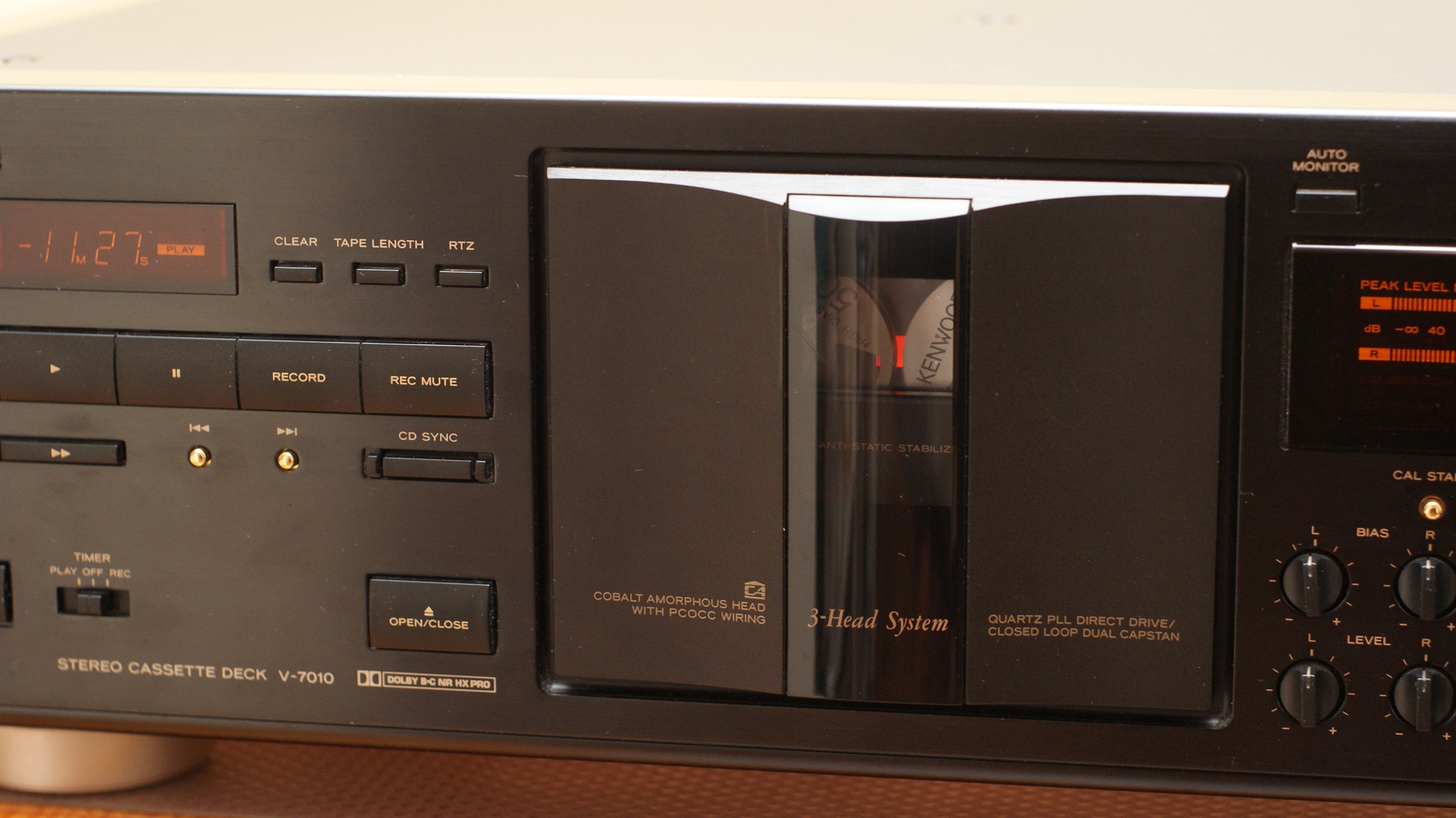
The cassette door on the V-7010 is very solid and heavy, seemingly more so than on the V-7000. The cassette holder itself is almost identical in construction and feels extremely robust. Aside from some very minor changes, the most noticeable addition is a small anti-vibration pad on the mechanism cover of the newer model, directly beneath the cassette.
So, one could say that the TEAC V-7010 is not merely a cosmetically updated version of the popular V-7000, but rather a tuned and refined one. There may well be other differences I haven’t noticed, and it is also quite possible that the sound is different as well.
REPAIR
As mentioned earlier, the deck arrived faulty: the main (capstan) motor was running at five times the correct speed, making playback sound like every recording featured Donald Duck as the performer. This clearly indicated a problem with motor control or the servo loop.

The service manual does not include the schematic of the motor control circuit itself, but my first suspicion fell on the electrolytic capacitors. Failures and leakage are common, especially with aluminum SMD capacitors, although in this case there were three small conventional electrolytics, which fail less often than their SMD counterparts.

I prepared some basic equipment: a power supply and an RPM counter I had purchased for general use. These were necessary because the motor is powered solely from a common +12 V supply, meaning it does not require multiple voltages and can be run from an external source without connecting it to the rest of the deck’s electronics during testing.
The RPM counter I bought supports both contact and non-contact measurement. Since the initial speed was about five times too high, all that remained was to measure the RPM (no belt connecting the two flywheels was needed) and then check the new RPM after repair to see whether it differed by a factor of five. Simple enough. This approach spared me from repeatedly connecting and disconnecting cables, risking connector damage, repositioning the mechanism, and potentially scratching or damaging other components or the chassis.
It turned out that all three 10 µF / 25 V capacitors had failed and caused some damage to the PCB. What concerned me most was the area beneath the motor controller IC (M56730ASP), which I found to be a chip originally designed for spindle motors in old floppy disk drives and VCRs.

Since part of the PCB runs underneath the IC itself, I initially considered removing it with hot air, but instead I contacted my friend Voja, an expert in audio electronics. Voja (thank you so much, Voja!) explained that because the PCB is mounted on a metal plate, the risk of damaging the copper traces is high—the metal would dissipate heat, requiring a higher hot-air temperature, which would very likely damage the PCB, possibly beyond repair. He suggested using an infrared soldering station, but also advised me to first try cleaning the traces and see what happened.
That’s exactly what I did. I bought isopropyl alcohol and carefully cleaned the entire board using a soft brush and a toothbrush. With a gentle brush, I even managed to clean residue from underneath the IC.

After that, I submerged the entire board in isopropyl alcohol in an ultrasonic cleaner for 15 minutes, then dried it thoroughly.
I should note that a multi-part blog I found online was very helpful. I sincerely hoped I wouldn’t encounter the same issues as the deck owner described there, but I was only partially lucky.
Continuity testing revealed that the speed sensor trace was broken as well—just like in the case described in the blog—fortunately only one trace and at a single point. I repaired it symmetrically on both sides, just to be safe.
After the repair, I rechecked the flywheel speed. The result was around 361–362 RPM, which matched my calculations and was far lower than the initial 2,100 RPM.

I then applied Plastik 70 protective lacquer to the initial section of the printed encoder and beneath the controller IC, carefully using a brush.

The pinch rollers looked like new, but felt slightly hardened to the touch—a result of age—so I replaced them as well.

The small rubber belt used for tape tensioning had completely disintegrated, requiring partial disassembly to clean and remove the residue. Additionally, the “checkerboard” sticker on one of the wheels had come loose, so I carefully reattached it. It’s best to handle this sticker with your fingers; any attempt to use tweezers may damage it. I cleaned the sticker surface using cotton swabs and moisture from breath (distilled water can also be used), never any stronger solvents or even mild ones like alcohol, as they will damage the printed pattern. I say this from experience—once I stripped the print off a sticker and had to recreate it on a computer and print it on metallized adhesive foil.

Overall, the transport was in excellent condition, and the faults were purely age-related. Left unaddressed, they could have led to an almost irreparable situation, which would have been a real shame. The interior of the deck contained very little dust, while the copper-plated chassis—still bright as on day one—was truly a sight to behold.

Finally, I performed an internal calibration and measured the frequency response, which matched the specifications. For calibration, I used Maxell UR and XLII tapes, as well as TDK MA; I do not have suitable TEAC tapes in my collection. During adjustment, I was surprised to find that the factory-set azimuth was actually misaligned, so I corrected that as well.
Just to mention, the whole repair, adjustments and tests took me 18 hours of work.
TEAC V-7010 IN PRACTICE
The TEAC V-7010 is generally easy to use, with a solid control layout, though not without some odd choices. For example, the Dolby selector is located in the upper-right corner, and the monitor button is also placed somewhat unusually—perhaps intentionally to avoid accidental operation.
The calibration activation button, along with others of the same size, is too small. Interestingly, it is made of brushed metal like the other similarly shaped buttons, while most others are plastic, except for the recording level control. Personally, I would prefer more metal and less plastic.
The main transport control buttons are identical, moderately well labeled, but ergonomically they could have been executed much better—something that was fully corrected in the C-8030/6030 models.

Operating status is indicated by small icons next to the counter; this could have been done more elegantly.
The peak meters are large and informative, sufficiently precise around the crucial 0 dB area, with a digital peak display that must be reset manually—there is no automatic reset option, which is a pity. The counter itself lacks any remaining-time display, which would have been useful.
The calibration system is almost perfectly implemented and easy to use. What seems illogical to me is that when calibration is activated, it starts with recording level (sensitivity) adjustment, but the corresponding potentiometers are not the top row beneath the calibration button—as one would expect—but the bottom row. The bias potentiometers are above them. In practice, this means you activate calibration, adjust the bottom potentiometers, then press the calibration button again to switch to bias adjustment, and then move back to the top row. Quite illogical.
SOUND
TEAC has never made major mistakes with its top models, some of which are truly outstanding. The V-7010 is no exception.
On normal tapes (TDK D, Maxell UR), the V-7010 sounds very precise and clean. HX Pro is solidly implemented and generally does not cause problems with sibilance. When comparing input and output, it is quite difficult to notice any difference; the sound of the 7010 is very well polished, with a character that leans toward a brighter and extremely clean presentation—something that became common in the 1990s. Advances in technology led even higher-end cassette decks to adopt sound characteristics reminiscent of CD players, although some of them lost a degree of naturalness, which fortunately is not the case with the V-7010. This is certainly helped by its advanced transport mechanism, which gives it an advantage over some similarly priced competitors, such as the Harman/Kardon TD4500, whose sound is very hard to rival if you prefer decks that are more neutral rather than warm. The TEAC V-7010 is slightly warmer than the Harman, but the ease with which the TD4500 handles high frequencies and overall transparency is something rarely encountered and long remembered, making that deck better than many three-head machines and one of the best two-head decks I have ever had the opportunity to hear.

Switching to chrome tapes (Maxell XLII):
Based on what I heard, the TEAC V-7010 belongs to the group of decks that benefit greatly from switching to good-quality (though not overly expensive) chrome cassettes. In other words, it is worth feeding it a decent chrome tape instead of a basic normal one, and the results will not disappoint. TEAC is not alone in this regard—Technics RS-AZ6 and AZ7 are similar, although those Technics decks truly begin to shine when used with metal tapes.
There are also decks with a different character: most Nakamichi models record superbly on almost any cassette you put into them; the Revox B-215 is also excellent, as are models like the Harman/Kardon TD-4800, and others.
When comparing recordings made on chrome versus normal tapes, the V-7010 delivers noticeably more in both the upper treble and the midrange. High frequencies are cleaner, more transparent, reproduced with greater precision and ease, and in a way that feels positively more aggressive than on normal tapes.
Metal tape (TDK MA):
Using a TDK MA produced almost identical results to those obtained with the Maxell XLII chrome tape—so much so that in a blind test I would not be able to tell whether I was using a chrome or a metal tape. Although there are probably some advantages to using metal tapes over normal ones (apart from slightly lower noise), I honestly did not hear them.

One thing I did not like during recording was an occasional, not always present, slight artificial coloration in human voices. As mentioned, this coloration is not constant, but a trained ear will notice it when it appears, and it can be mildly annoying at times. Some experimentation with sonically softer interconnects helped, as did extended use of the deck (it had clearly been unused for a long time and needed time to settle in). This issue occurred more often on normal tapes than on chrome or metal, and I have observed similar behavior with some other models that implement the HX Pro system.
My conclusion is that on this deck, recordings for which you want to push maximum quality should be made on solid chrome tapes, while normal tapes are perfectly adequate for everything else. Metal tapes are significantly more expensive (and always have been), and there is really no need to use them with the TEAC V-7010.
CONCLUSION
Is the TEAC V-7010 sonically better than its predecessor, the V-7000? Based on my recollection of the V-7000’s sound, I would say yes. Is the difference large? It does not seem drastic to me, but it is noticeable. In my view, the TEAC V-7010 is essentially a finely tuned version of the older model. As for the sound and the device as a whole—it fully justifies its original price and clearly belongs to the upper class of these audio components.
I will soon be servicing a Sony TC-K970ES, and I already own one, so it will be a good opportunity to compare the V-7010 with the V-6030S, which I also have in my collection, as well as with the aforementioned Sony deck.

